Sky blue ticket-stub motifs for airline cabin crew.
Create a free account to customize and publish this design.
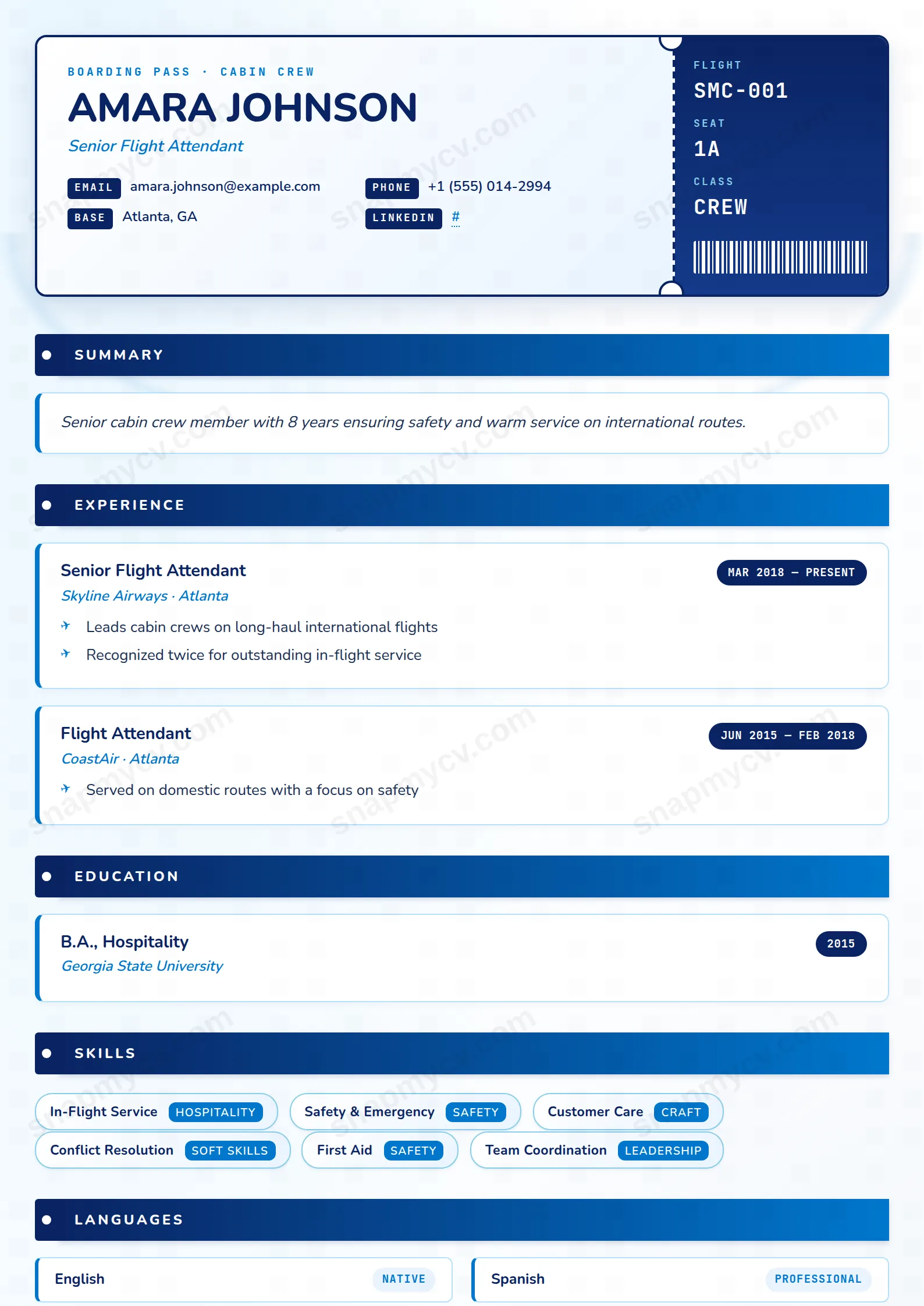
Sky-blue ticket-stub motifs and crisp section breaks give cabin-crew applications the polish airlines expect, with space for certifications, languages, and service highlights.
Best for: airline cabin crew and aviation service roles. Free to fill in, restyle, download as a PDF, or publish at your own SnapMyCV link.
Applicant tracking systems: ATS-friendly. Single-column, standard section headers, parses cleanly in most applicant tracking systems.A template's styling never changes the advice that matters most — lead with achievements, quantify your impact, and tailor the content to each role.
New to writing a CV? Read our step-by-step CV guide and ATS tips, then come back and make this design your own.
Flight Crew commits fully to one metaphor and lets it carry the whole layout. The header is a literal boarding pass: your name set in bold uppercase Nunito next to a deep navy #0a2463 tear-off stub printed in JetBrains Mono, with FLIGHT, SEAT and CLASS rows and a generated barcode strip. Perforation notches and a dashed divider complete the ticket, and a faint sky-blue flight-path arc curves behind everything on a white-to-#f4faff wash. The monospace stub is a deliberate counterweight to Nunito's rounded warmth, borrowing the clipped, official feel of real crew paperwork so the novelty reads as craft rather than gimmick.
The palette stays disciplined around aviation blues. Navy #0a2463 does the ink and headings, sky blue #87ceeb handles borders and chips, and a brighter #0077cc marks accents. Section titles ride ticket-stub tabs finished with a pointed boarding-gate notch, while experience and education sit in clean left-bordered cards and every bullet carries a tilted plane glyph. Skills become rounded badges, languages pair into a two-column grid, and hobbies drop into dashed tags. The result has a lot of decorative incident, but it is anchored by a single straight column so the eye still travels top to bottom without hunting.
This is built first for cabin crew, flight attendants and aspiring airline staff, and the details reward that audience: the contact row labels your city as BASE and your links as keyed tags, so the whole thing scans like crew documentation. It stretches naturally to cruise, hospitality, tourism and front-of-house roles where warmth and service are the pitch, and the italic summary panel gives you room for a confident, people-first opening line.
Be honest about where it does not belong. If you are applying into law, finance, academia, government or senior corporate roles, the barcode, plane glyphs and boarding-gate notches will read as costume rather than credential. The same goes for conservative ATS-heavy pipelines where a hiring panel expects a plain, sober document. Pick Flight Crew when the aviation or hospitality theme is an asset you want the reader to feel instantly, not when you need the design to disappear.
Treat the boarding-pass header as fixed furniture and feed it clean inputs: your name works best short enough to sit beside the stub without wrapping, and the BASE label wants a real city rather than a full address. Inside each left-bordered role card, write two or three tight highlight lines and steer them toward safety, service recovery, boarding turnaround and languages spoken in the air, since that is the vocabulary this template is dressed for. Keep skill names to one or two words so the rounded badges stay even, and lean on the two-column languages grid, because multilingual crew is exactly what airlines scan for.
The common mistake is overfilling. Long paragraph summaries break the italic panel, wordy bullets crowd the plane glyphs, and a wall of skill badges turns the tidy chip row into visual noise. Aim for a single-page rhythm: a two or three sentence summary, three to five roles, six to ten short skill badges and a generous languages block. The single-column flow keeps a recruiter moving down the page the way a boarding queue moves forward, so protect that momentum by keeping every block short and scannable.
The body is real selectable text in one column with standard headings, which parsers handle well. The risk sits in the decorative header: the navy stub, barcode strip and keyed contact tags are styling, so a parser may not map BASE to your location or read the stub rows cleanly. Copy the rendered CV into a blank document first and confirm your name, dates and bullets survive in order before you submit.
It leans heavily on its aviation blues, so greyscale printing flattens the navy #0a2463, sky blue #87ceeb and #0077cc accent into similar greys. The structure still reads because the ticket-stub tabs, left-bordered cards, perforation notches and plane-glyph bullets carry shape rather than colour, but the boarding-pass illusion loses much of its punch. For colour-dependent impact, share it as a PDF or on screen rather than a black-and-white printout.